 EN
EN
 INA
INA
INDONESIAN BIOMEDICAL SCIENCE CONSORTIUM XV NATIONAL WORKING RALLY JAKARTA, MAY 11-13, 2026 News and Activities
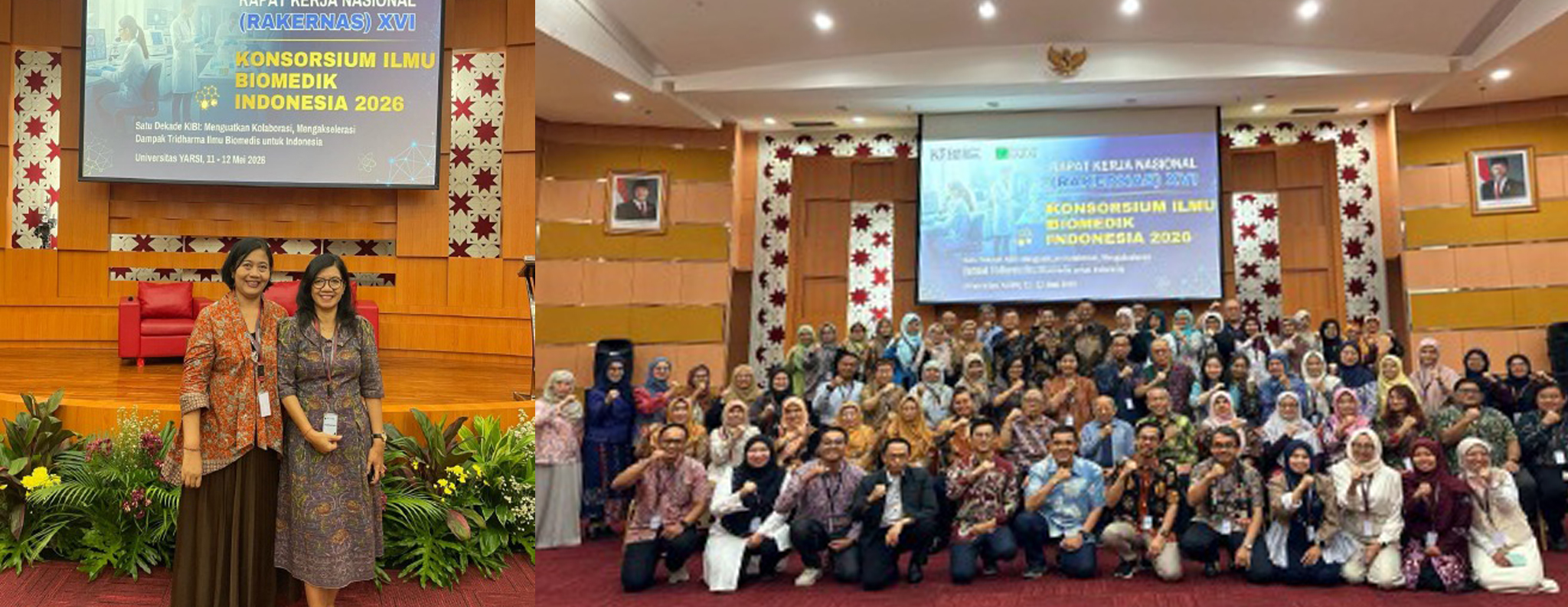
JAKARTA — The Indonesian Biomedical Sciences Consortium (KIBI) officially held its 2026 National Working Meeting (Rakernas) to mark its first decade in the country. With the main theme "One Decade of KIBI: Strengthening Collaboration, Accelerating the Impact of the Tridharma of Biomedical Sciences for Indonesia," this strategic forum was held as a forum for evaluation, coordination, and policy formulation to optimize the contribution of biomedical science to national health resilience.
The development of biomedical science currently plays a vital role in advancing the quality of public health and strengthening the national health system based on research and innovation. Universities, as centers of scientific development, bear full responsibility for optimally implementing the Tridharma of Higher Education—from education and research to community service. To achieve this, strong synergy and collaboration between higher education institutions are key, particularly in the dynamic field of biomedical science.
A Decade of Reflections and the Strength of the National Network
As a strategic platform that brings together various study programs and stakeholders in the biomedical field, KIBI continues to experience significant growth. Entering its tenth year, KIBI has now transformed into a solid academic force with 38 member programs at the undergraduate, graduate, and doctoral levels across 26 universities across Indonesia.
Throughout its history, KIBI has actively contributed to improving the quality of education, harmonizing the national curriculum, and developing cross-institutional research collaborations. This decade-long momentum is positioned as a time to reflect on achievements and as a strategic stepping stone in responding to the dynamics of higher education policy and the demands for outcome-based performance quality assurance.
The Four Main Pillars of the 2026 KIBI National Working Meeting
Through the 2026 National Working Meeting, the administrators and members formulated concrete steps based on four main objectives, including:
Forging Relationships and Partnerships: Strengthening family ties and increasing commitment to integrative cooperation among all KIBI members.
Organizational Performance Accountability: Submitting performance reports from each KIBI management division as a form of transparency and periodic work program evaluation.
Strengthening the Tridharma Network: Expanding and strengthening cross-institutional collaboration in education, joint research productivity, and downstreaming community service.
Real Science-Based Action: Directly applying scientific expertise through a national community service agenda integrated with the series of national working meetings.
Real Community Service Action: Accelerating Tuberculosis Elimination
As a concrete manifestation of the implementation of the Tridharma, this series of National Working Meetings is combined with the 5th KIBI National Community Service agenda. This socio-scientific activity raised a crucial public health theme: "Early Detection of Infectious Diseases and Enhancing the Role of Families in Eliminating Tuberculosis (TB)."
Efforts to eliminate tuberculosis cannot rely solely on health care facilities; they require an aggressive promotive and preventive approach at the community level. The active role of families has been scientifically proven to be a determining factor in successful therapy, medication adherence, and breaking the chain of transmission within the household.
Through this community service activity, KIBI deployed experts and academics to raise public awareness about the importance of early detection of infectious diseases. Furthermore, this program is designed to strengthen the capacity of families as the primary supporting pillars in early detection, and to apply the results of cutting-edge biomedical research and innovation so that their impact can be directly felt by the wider community, towards realizing a tuberculosis-free Indonesia.
UDAYANA UNIVERSITY