 EN
 INA
The 500th Graduate of the Faculty of Medicine's Doctoral Program Develops a Health Information System (MIS-Dinkes) to Support Smart Health in Badung Regency News and Activities
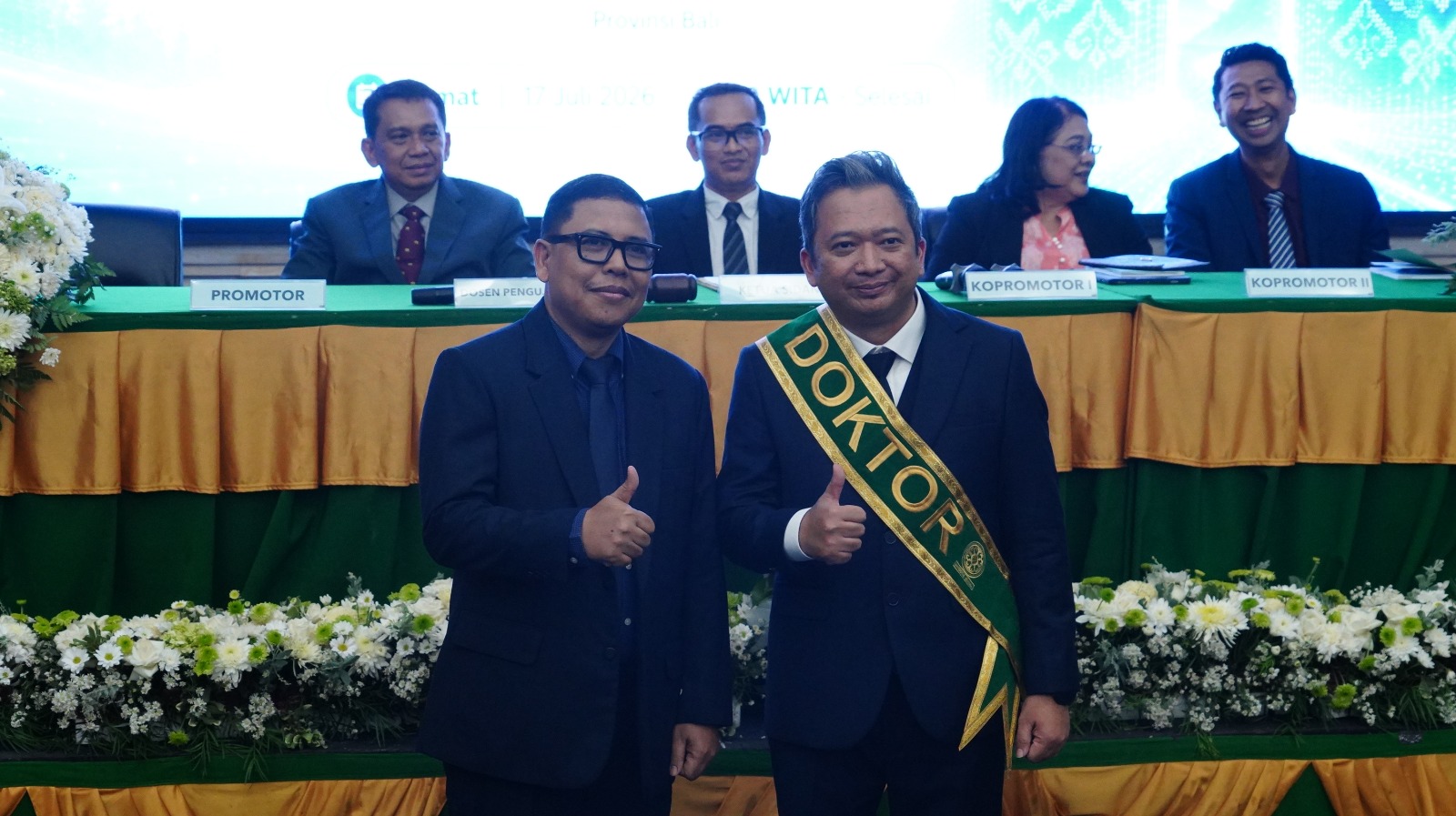
Held in the Dr. A.A. Made
Djelantik Meeting Room, 4th Floor, Faculty of Medicine Building, Udayana
University, the Doctoral Program in Biomedical Sciences, Faculty of Medicine,
Udayana University, held an open doctoral promotion defense with Dr. Bagus Padma
Puspita, Sp.PD, MARS., as the candidate for the dissertation, entitled
"Development of a Health Office Management Information System (MIS-Dinkes)
in Supporting the Digital Transformation of Public Health Services in Badung
Regency, Bali Province." (July 17, 2026)
Digital health transformation is
a strategic necessity for strengthening efficient, integrated, responsive, and
data-driven regional health service governance. Badung Regency, as a region
with high population mobility and the development of a smart city, requires a
health information system capable of integrating data across facilities,
reducing duplication of records, accelerating reporting, and supporting
evidence-based decision-making. The current health information system remains
fragmented at the community health center (Puskesmas), hospital, and health
office levels, thus failing to optimally support the digital transformation of
healthcare services. This research aims to develop the Health Office Management
Information System (SIM-Dinkes) as an integrated regional health management
information system to support the digital transformation of public healthcare
services in Badung Regency.
This research employed an
exploratory sequential mixed methods design, beginning with a qualitative study
and continuing with a quantitative study. The qualitative phase involved
in-depth interviews and focus group discussions with 27 expert panels, 45 healthcare
workers, 40 representatives of regional government organizations, and 10
community representatives. Data were analyzed thematically to identify
SIM-Dinkes development needs, formulate a grand design, and analyze benefits
from product feasibility, market feasibility, financial feasibility, and
organizational feasibility aspects. The quantitative phase was conducted
through a cross-sectional survey using the Health Information Technology
Usability Evaluation Scale (Health-ITUES) instrument among users of the
SIM-Dinkes prototype through the Badung Sehat Mobile application. 364
respondents participated in the Disease Distribution feature, 364 in the
Emergency Service feature, and 483 in the Home Care Service feature.
The qualitative research results
indicate that developing SIM-Dinkes requires institutional commitment, program
sustainability, cross-sector data integration, a National Identification Number
(NIK)-based database, human resource readiness, data security and verification,
technological infrastructure, formal regulations, and collaboration across
regional government agencies. The grand design of SIM-Dinkes encompasses three
main domains: the Individual Information System, the Community Information
System, and the Performance Information System, with key features being Disease
Distribution, Emergency Services, and Home Care Services. A feasibility
analysis indicates that SIM-Dinkes is feasible to develop from the perspectives
of product feasibility, market feasibility, financial feasibility, and
organizational feasibility. The quantitative research results showed that user
acceptance of the SIM-Dinkes prototype was very positive, with the proportion
of agree and strongly agree responses ranging from 94.51%–99.45% for the
Disease Distribution feature, 93.13%–100.00% for the Emergency feature, and
93.37%–99.17% for the Home Care Service feature.
The conclusion of this study is
that the development of a SIM-Dinkes integrated with the smart city concept is
feasible and necessary to support the digital transformation of public health
services in Badung Regency, with a high level of user acceptance for all tested
features. SIM-Dinkes has the potential to become a model for an integrated,
adaptive, and sustainable regional health information system, making it worthy
of further development and large-scale implementation testing.
The testing was led by the Vice
Dean for Academic and Planning, Faculty of Medicine, Udayana University, Prof.
Dr. I Made Ady Wirawan, S.Ked., MPH., Ph.D., with the following team of
examiners:
1. Prof. Dr. Pande Putu Januraga,
M.Kes., Dr.PH. (Promoter)
2. Prof. Dr. Dr. Ni Nyoman Sri
Budayanti, Sp.MK (K) (Copromotor I)
3. Cokorda Rai Adi Pramartha,
S.T, M.M., Ph.D (Copromotor II)
4. Prof. Dr. Dr. I Made Jawi, M.
Kes
5. Prof. Dr. Dr. Erwin Astha
Triyono, Sp.PD-KPTI, FINASIM
6. Prof. Dr. Dr. A A. Wiradewi
Lestari, Sp.PK, Subsp.BDKT(K), Subsp KV(K)
7. Prof. Dr. Dr. Cokorda Bagus
Jaya Lesmana, S.Ked., Sp.KJ(K), MARS
8.Dr. Luh Seri Ani, SKM., M.Kes
9.Dr. Ni Ketut Sutiari, SKM.,
M.Si
By academic invitation:
1. Dr. dr. I Gusti Putu Suka
Aryana, Sp.PD, K-Ger, FINASIM
2. Dr. I Wayan Sumardika, S.Ked.,
M.Med.Ed., Ph.D
3. Dr. dr. Ketut Kwartantaya
Winaya, Sp.KK(K)., FINSDV., FAADV
4. Dr. dr. I Wayan Losen Adnyana
UDAYANA UNIVERSITY