 EN
 INA
Biomedical Science Doctorate Researches Biomarkers That Can Predict the Risk of Colorectal Cancer Spread News and Activities
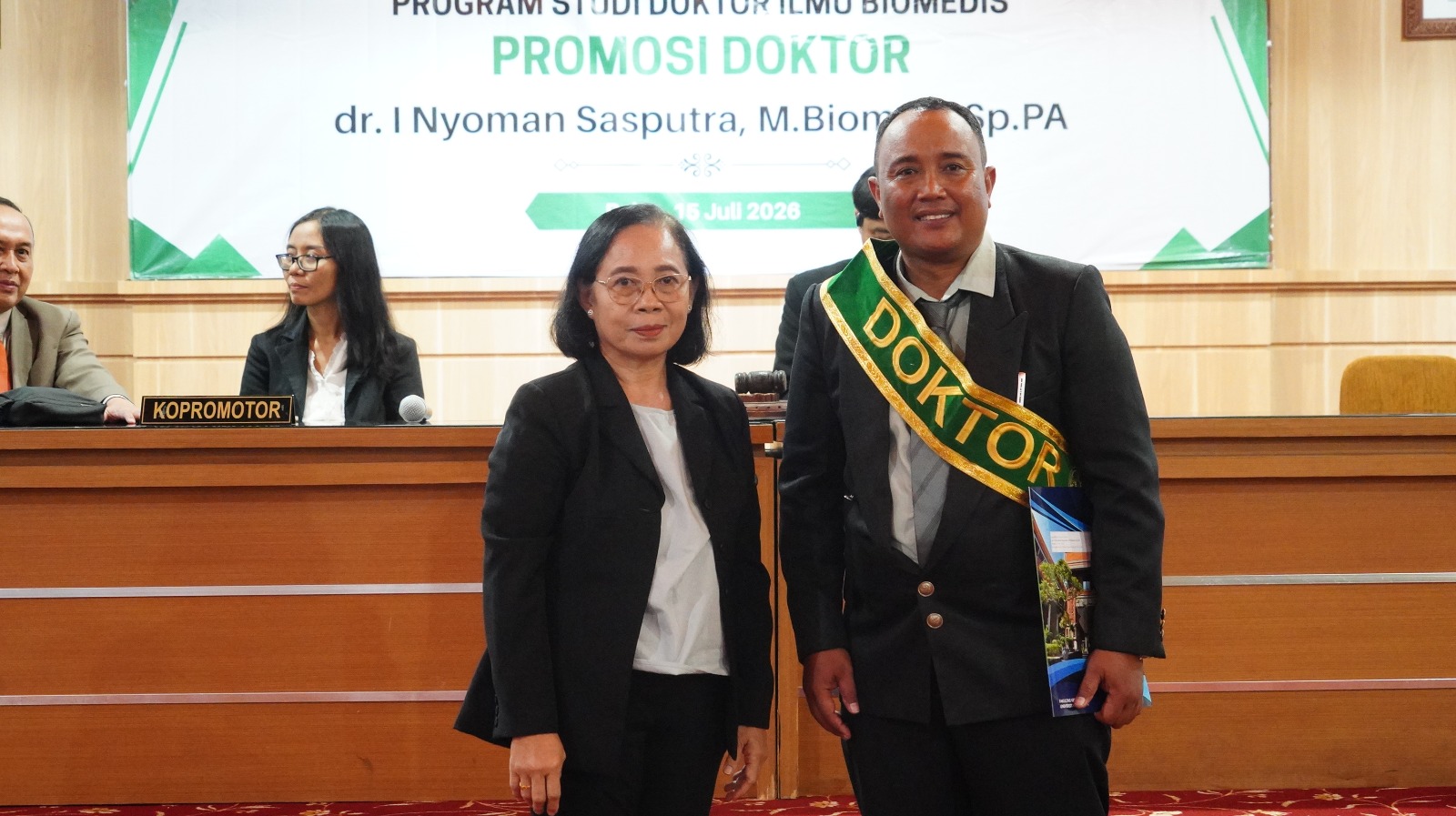
Held in the Meeting Room on the
Third Floor of the Postgraduate Building of Udayana University, Jl. PB
Sudirman, Denpasar, Bali, the Biomedical Science Doctoral Study Program,
Faculty of Medicine, Udayana University, held an open doctoral promotion defense
with candidate Dr. I Nyoman Sasputra, M.Biomed., Sp.PA., for the dissertation
"High Expression of Transforming Growth Factor-? (Tgf-?), Fibronectin
(Fn), and Programmed Death-Ligand 1 (Pdl1) as a Risk Factor for Metastasis in
Colorectal Adenocarcinoma." (July 15, 2026)
Colorectal adenocarcinoma is the
third most common malignancy and the leading cause of death among
gastrointestinal cancers. The risk of death in colorectal adenocarcinoma
patients increases if metastasis has occurred. The use of biomarkers to
determine risk factors for colorectal adenocarcinoma metastasis has been less
than satisfactory, so research is needed to identify more robust biomarkers for
determining metastasis risk factors. This study aims to demonstrate the risk of
metastasis in patients with high TGF-?, fibronectin, and PD-L1 protein
expression compared to those with low TGF-?, fibronectin, and PD-L1 protein
expression.
This study used a nested
case-control design. The sample size for this study was 84 colorectal
adenocarcinoma patients from the Anatomical Pathology Laboratory of Prof. Dr. I
G.N.G. Ngoerah General Hospital, Denpasar, from June 1, 2021, to July 1, 2024. A
total of 42 non-metastatic colorectal adenocarcinoma patients served as
controls, and 42 metastatic colorectal adenocarcinoma patients served as cases.
TGF-?, fibronectin, and PD-L1 protein expression were assessed using
immunohistochemistry, chi-square test, odds ratio, and logistic regression
analysis with a significance level of p< 0.05.
The risk of metastasis was higher
in colorectal adenocarcinomas with high TGF-? protein expression (RR=2.9; 95%
CI: 2.074–4.081; p< 0.001), high PD-L1 protein expression by 22 times
(OR=22.0; 95% CI: 7.065–68.505; p< 0.001), while all fibronectin protein
expression was categorized as high. Multivariate logistic regression analysis
showed high PD-L1 protein expression with a positive regression coefficient (B
= 4.213; p< 0.001) and an odds ratio of 67.557 (95% CI: 11.366–401.562).
The study concluded that high
TGF-? and PD-L1 protein expression are significant risk factors for colorectal
adenocarcinoma metastasis. The risk of metastasis cannot be assessed from
fibronectin expression. Fibronectin expression was equally high in colorectal
adenocarcinoma with and without metastasis.
This examination was led by the
Vice Dean for General Affairs and Finance, Faculty of Medicine, Udayana
University, Prof. Dr. dr. I Made Muliarta, S.Ked., M.Kes., with the following
examiners:
1. Prof. Dr. dr. I Gusti Ayu Sri
Mahendra Dewi, Sp.PA., Subsp.O.G.P.(K) (Promoter)
2. Dr. dr. Gede Wirya Kusuma
Duarsa, Sp.U, Subsp.Ped., M.Kes., MARS (Co-Promoter I)
3. Dr. dr. Ni Putu Sriwidyani,
Sp.PA., Subsp.S.M.(K) (Co-Promoter II)
4. Prof. Dr. dr. I Made Jawi,
M.Kes
5. Prof. Dr. dr. I Wayan Putu
Sutirta Yasa, M.Si
6. Prof. Dr. Drs. I Ketut
Sudiana, M.Si
7. Dr. dr. Ida Ayu Ika
Wahyuniari, M.Kes
8. Dr. dr. I Kadek Swastika,
S.Ked., M.Kes
9. Dr. dr. I Gusti Agung Gede
Utara Hartawan, Sp.An-TI., MARS., SH
By academic invitation:
1. Dr. dr. I Wayan Sugiritama,
M.Kes
2. Dr. dr. I Gusti Lanang Ngurah
Agung Artha Wiguna, S.Ked., Sp.OT(K)..
3. Dr. dr. I Wayan Juli Sumadi,
Sp.PA., Subsp.M.S(K)
4. Dr. dr. Ni Wayan
Armerinayanti, M.Biomed., Sp.PA
5. Dr. dr. I Wayan Lolik Lesmana,
M.Biomed., Sp.THT-BKL., Subsp.Onk(K)
During this examination, Dr. dr. I Nyoman Sasputra, M.Biomed., Sp.PA., was declared the 499th graduate of the Doctoral Program in Biomedical Sciences, Faculty of Medicine, Udayana University, with a Very Satisfactory Grade.
UDAYANA UNIVERSITY